
How Do We Work Together?


In-depth
Financial Planning

Custom Investment Management

Advanced Tax
Strategy
What Executives Ask Before They Decide
Do you work with people in my situation?
If you’re a VP, SVP, Director, or Department Head and you know the complexity you’re carrying deserves more than a generalist’s attention, you’re probably already a fit.
The clearest sign: you’re within 5–10 years of a transition you can’t undo.
Our clients typically have household income above $300K and investable assets between $2M and $10M. Most carry some combination of deferred compensation, RSUs, stock options, properties, pensions, and multiple accounts that no single person has ever pulled together into a coherent strategy. That’s the gap we fill.
If you’re earlier in your career, still building, or primarily looking for investment management, we’re not the right fit.
Do you work with clients outside Colorado?
Yes. MARGIN serves executive families nationwide through virtual meetings. Denver is our home base, and we meet in person when clients are local or visiting, but the practice is built for executives wherever they live and work.
What makes you different from other financial advisors?
Most advisors just manage your investments. That is one piece of a much larger puzzle.
For executives with your level of complexity, the real risk is not a bad stock pick. It is a deferred comp election made without modeling its impact on your tax picture in retirement. It is company stock, accounting for 40% of your net worth, with no coordinated plan to reduce it. It is a Roth conversion window closing because nobody ran the numbers. It is your CPA and your advisor working in separate silos, neither one owning the coordination between them.
We build one integrated strategy that holds everything together: your deferred compensation elections, your RSU vesting schedule, your Roth conversion window, your Social Security timing, your state tax exposure, and your retirement date. A change in any one of those changes the optimal answer for all the others.
Here is what that looks like in practice.
Twice a year, we run structured planning meetings built around your situation. Before your year-end meeting, you receive a personalized video reviewing your financial plan, investments, tax strategy, and any open recommendations. You can watch it on your own schedule, before we meet. It means our time together is spent making decisions. We also run a dedicated tax and investment strategy meeting each spring, timed to your returns and the opportunities they present.
Between those meetings, we run a comprehensive and customized checklist review across every area of your financial life, the way a mechanic inspects a car before a long trip. Concentration risk, Roth conversion windows, deferred comp elections, beneficiary designations, estate documents, ACA and IRMAA impacts, and equity vesting. Nothing gets skipped because it is complicated or inconvenient.
The technical depth behind all of this matters because your situation requires it. Eric holds the CFA, CFP, and CAIA designations, a combination held by fewer than 1 in 4,000 advisors, and has spent 18 years working specifically with executives navigating this complexity. When you describe your situation, we already speak the language.
How this is different from a large firm? A big firm can do much of this too. The bigger national firms run tax projections and have deferred comp specialists. The capability is rarely the question. The question is whether it happens for you, on time, by someone who knows your situation. At a large firm, the specialist who understands your 457(f) plan exists, but you may never speak to them. You get a relationship manager, and the specialist is shared across hundreds of accounts. The work gets done if you ask, and if your account is large enough to move up the queue. Here, the person who knows your equity comp is the person who answers your call. You are a select family we work with, not hundreds or even thousands. A deferred comp election set for the wrong year is rarely a capability gap. It is an attention gap. That is what we are built to close.
Our clients stop carrying the low-grade anxiety of knowing their financial picture is complicated and wondering if anyone is actually watching the whole thing. They know someone is.
What does working with you actually look like?
It starts with a 30-minute strategy session to make sure there is a fit. If we move forward, the first 90 days are when we do the heavy lifting.
You provide your financial documents: tax returns, account statements, compensation details, benefits summaries, and estate documents. We take it from there. What comes out the other side is a comprehensive strategy that ties every decision you are facing into a single, coordinated framework. Most clients tell us that the process alone surfaces things nobody had caught before.
After that, the relationship shifts into a rhythm. We meet at least twice a year. A spring tax and investment strategy meeting timed around your returns and the planning opportunities that come with them. A fall comprehensive review that covers everything on the horizon before year-end deadlines arrive. In between those meetings, we are monitoring. When something changes, a tax law, a new comp package, a market move that creates a planning opportunity, we reach out. You do not have to remember to call us. That is our job.
If you have an existing advisor, CPA, or other professional you work with, we handle the coordination. You do not manage the handoff. We do.
Who else will I work with besides Eric?
Eric is the advisor on every engagement. He is supported by a paraplanner and an operations team who handle execution, document gathering, and client service. The planning, tax work, and investment decisions are done by the advisor you hired, not handed off to an associate. MARGIN is structured this way on purpose. Senior executive situations require the person doing the work to hold the full picture, and the client roster is sized to make that possible.
How much does this cost?
We charge based on assets under management. The fee is 0.90% annually on the first $2.5M and 0.65% on assets between $2.5M and $5M, with a $15,000 annual minimum.
That number is worth putting in context.
For most of our clients, the fee covers everything: investment management, tax strategy, retirement planning, year-round monitoring, and structured planning meetings.
The more relevant comparison is not what we charge versus what another advisor charges. It is what proactive planning is worth against the decisions that cannot be undone. A deferred comp election was set up for the wrong distribution year. A Roth conversion window was missed because nobody ran the numbers in time. Company stock is sitting at a concentration level that exposes you to a tax event you did not see coming. These are not hypothetical risks. They are the situations we were hired to prevent.
What we consistently find is that the tax strategy work we do in the first year identifies more value than the annual fee. We cannot promise that, because every situation is different. What we can tell you is that it is the pattern, and we built our process specifically to find it.
If the math does not work for your situation, we will tell you directly. We would rather have that conversation before you become a client than after.
I already have a financial advisor. Can you just help with my deferred comp / equity / tax situation?
We hear this often, and it usually tells us something important: you already know where the gap is.
The issue is rarely that your current advisor is doing something wrong. The issue is that they were hired to manage your investments, but nobody was ever hired to coordinate your deferred comp elections, your equity vesting, your tax strategy, and your retirement timeline. Those pieces live in different places, and nobody is modeling how they interact. That is not a performance problem. It is a structural one.
The biggest financial mistakes we see for executives happen at exactly those intersections. A deferred comp distribution is scheduled in the wrong year. A Roth conversion window that closes because the RSU vesting or deferred compensation income pushed the numbers past the threshold. The company stock concentration was never addressed because reducing it was always someone else’s job. These are not exotic edge cases. They are what happens when the pieces are not coordinated.
To answer your direct question: our work is built around ongoing coordination, not one-time projects. A standalone deferred comp review would give you an answer without the context of your full picture, and that is how the intersections get missed.
We can have a direct conversation about your specific situation. If the coordination gap you are describing is something your current advisor can address with the right questions, we will tell you what to ask them. If there is a structural gap that is costing you real money, we will show you exactly where it is.
Either way, you will leave that conversation with more clarity than you came in with.
Are you a fiduciary?
Yes. MARGIN is a fee-only registered investment advisor. We do not sell products, earn commissions, or receive compensation from any third party. Legally and structurally, we are required to act in your best interest.
But we think the more useful answer is what a fiduciary looks like in practice.
It means we will tell you when a strategy is not worth the complexity. When the projected tax savings do not justify the cost of executing the plan. When the best move for your situation is to do nothing and wait. Those conversations are easy to avoid when an advisor has an incentive to keep things moving. We do not have that incentive, so we do not avoid them.
It also means our fee is the only fee. When we recommend a fund, a structure, or a strategy, there is no revenue on the other side of that recommendation. The only thing that works for us long-term is a client who looks back in five years and believes the service we provided was worth every dollar they paid.
Where are my assets held?
Your assets are held at Charles Schwab, one of the largest independent custodians in the United States. MARGIN never takes custody of your funds.
That distinction matters. As your advisor, MARGIN has discretionary authority to manage your accounts, which means we can execute trades, rebalance, and implement the tax strategies we have built together. What we cannot do is move your money anywhere outside your own accounts. Your statements come directly from the custodian, not from us. You can log in and verify every transaction, balance, and holding independently at any time.
This is a structural protection, not a policy choice. It is how every legitimate fee-only RIA is set up, and it is one of the reasons the fee-only fiduciary model exists. The historical cases where advisors have mishandled client assets almost always involve an advisor who took custody directly. That is not possible in our structure.
If you are moving from a current advisor, we coordinate the custodian transfer on your behalf. You do not manage the paperwork or the handoff. We do.
I have a complex tax situation. Do you handle taxes or do I still need my CPA?
MARGIN can work with your tax professional who handles preparation directly.
Here is why that matters. Most executives have their financial advisor in one corner and their tax preparer in another, and neither one has the full picture when decisions need to be made. We work differently.
The forward-looking strategy, which determines when to take income, when to defer it, and how much to convert to Roth before the window closes. The strategy informs the filing. The filing reflects the strategy.
In practice, you hopefully see your returns in draft before anything is finalized and have an advisor review them. You have access to ask questions and understand what is being filed and why. There are no surprises at signing.
If you have an existing CPA relationship you want to keep, we can work alongside them and provide the forward-looking tax strategy directly.
What if I'm not sure I'm ready to retire? Can you still help?
Not being sure is not a problem to solve before you call us. It is the reason to call.
Most of the executives we work with carry a version of the same quiet tension: they are not sure if they can afford to leave yet, and they are not sure they will know when they can. So they wait. And while they wait, and the planning windows that would have given them the most options keep closing, one annual election at a time.
We replace that uncertainty with a specific picture. Not a rule of thumb. Not a generic retirement calculator. Your actual numbers, modeled across the timelines you are considering. What leaving at 58 looks like versus 62. What each scenario does to your taxes, your income in the first five years before Social Security, your deferred comp distributions, and your ability to sustain the life you have spent decades building toward. When you can see those scenarios side by side, the question stops being “am I ready?” and becomes “which of these do I actually want?” That is the moment the decision stops feeling paralyzing.
The executives who have the most freedom when the moment arrives are almost never the ones who started planning when they felt ready. They are the ones who started while they were still uncertain, still several years out, still not sure they would ever leave. That runway is not a luxury. For some of the most valuable moves available to you, it is the only thing that makes them possible.
You do not need to have decided. You just need to start.
What's the first step?
A 30-minute conversation.
You tell us where you are: your role, your compensation structure, where you think the gaps might be, and where you are in your thinking about what comes next. We ask the questions that help us understand the full picture. By the end of the call, you will know whether the coordination problems you have been carrying are as significant as you suspected, and whether we are the right firm to address them.
Most executives leave that conversation with at least one specific thing they had not considered before. That is the point of the call. Not to close you on becoming a client, but to give you a clearer picture of your situation than you came in with. If there is a fit, it will be obvious to both of us.
Our Fees
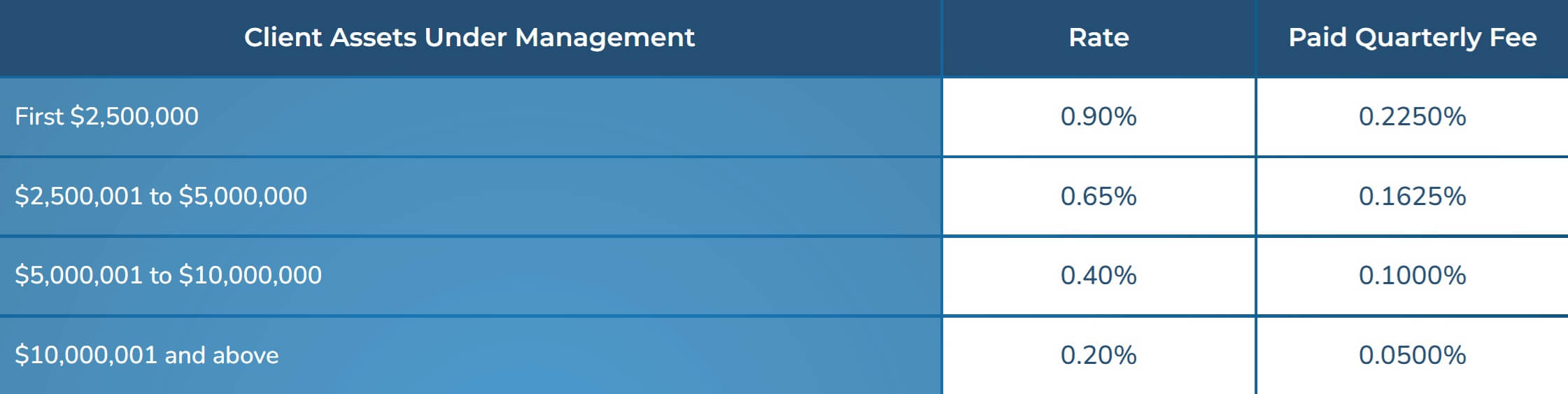
1. The asset-based fees described above are “blended” such that the percentage rates are applied to each corresponding range of assets, resulting in a combined fee. For example, a client with $3,500,000 under our management would pay 0.90% on the first $2,500,000 and 0.65% on the next $1,000,000.
2. There is a $15,000 minimum.
We add the most value:
With senior executives at an inflection point, the financial picture has outgrown the tools managing it.
You’re navigating deferred compensation, equity, or a concentrated stock position. A liquidity event or retirement date is on the horizon. And typically, household income of $500,000+ or investable assets of $2M+.